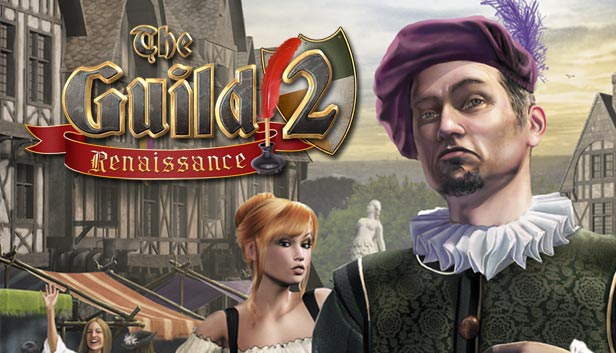
Although widely panned by critics and the internet at large as being unapproachable, anyone who commits the admittedly sizeable amount of time to learn the interface and the game will be rewarded with a fascinating look at dynasty development from the "over the shoulder" perspective of a 3rd person RPG or life simulation instead of the "grand strategy" perspective of offerings like Crusader Kings I/II.
One thing that should be mentioned is that JoWood followed a "repackaging" release cycle. What this means is that each "expansion" in the series is actually the compilation of all of the features of the previous releases in the series (sometimes without the maps). In other words, Renaissance, being the third and final "expansion", includes all of the buildings and actions that were added in all of the base The Guild 2, Pirates of the European Seas, and Venice. If you buy Renaissance, you've got the entire series at your disposal -- so don't be suckered into buying the other parts unless you know what you're doing.
However, without buying the original The Guild 2, you'll be left without the tutorials; though at least the GamersGate version of Renaissance includes the (sometimes poorly translated) game manuals, without the tutorials you can be in for a bumpy ride.
If you can afford it, pick up the original and play it just for sake of learning how to play. Since The Guild 2 and Renaissance cumulatively (when not on sale) add up to the same price as the entire The Guild 2 Platinum bundle, you might as well get the bundle for maximum value, although it'll be Renaissance you play in exclusivity -- so take your pick.
If you *can't* afford both, then Renaissance is your best bet; look for gameplay videos to learn how to play and sooner or later you'll pick up the game and start building dynasties with the best of them.
The game doesn't punish casual gameplay and represents both the benevolent productive and malevolent seedy sides of society. You can be an aggressive developer, fighting against other dynasties as you claw your way to the top, or you can take things slowly, forging alliances and letting other dynasties build their fortunes as well. If playing in Dynasty Mode, dare I say the only way the game should be played, the game is properly open ended and you can make your own goals.
While heavily lacking in balance (tip for newcomers: start as a Scholar, run a church, and hold sermons twice a day at dawn (06:00) and dusk (20:00) to earn substantial early-game income through tithes and collections), and at times feeling just a smidgeon too "gamey" to be a simulation and too "simulationy" to be a game, its take on late medieval life is very conducive to understanding. While much of the mod community has picked up their tents and moved on, the JoWood forum archives are still available at time of writing, and the game has an (almost) fully-modifiable Lua-based script system for you to play around with. Installing mods is not readily approachable for amateurs, however, so be warned: if you want to go that road, you may want to be a Craftsman with high Handiwork skill in real life -- note that many mods are made for previous versions of the game, so installing a pre-made script from an older version can cripple and break it.
The game is lacking in polish and has graphics that were outdated even when it was released several years ago. I would say the texture work and modelling is more to blame than the actual technology. It will take some playing around with the saturation, contrast, and brightness to have a nice, verdant, enjoyable game environment to play in, but once you do, you're actually in for a treat. While in particular the character models are in the wrong part of Uncanny Valley, the building models are top notch, and the item sprites are distinctive and identifiable.